

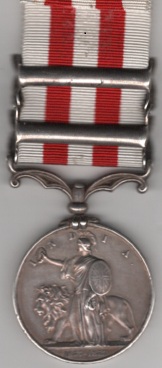
Description
John Maskery was born in Derbyshire in 1833. His address in the 1871 census was, Chetham Arms Inn, Sutton on the Hill, Burton upon Trent, Derbyshire, England. He was shipped to India to serve with the 2nd Bn, Rifle Brigade in the Camel Corps.
John Maskery served with the 2nd Battalion, Rifle Brigade in India during the Great Sepoy Mutiny, attached to the Camel Corps.
“He has the Indian Mutiny medal and clasps for Lucknow (capture) and Central India.” This unusual combination of clasps indicates that he was a member of the Camel Corps formed in April 1858, immediately after the capture of Lucknow (in which the 2nd and 3rd battalions of the Rifle Brigade had been very actively engaged), from 200 men of the Rifle Brigade, and later with as many Sikhs. The Camel Corps took a prominent part in Sir Hugh Rose’s very arduous but victorious Central India campaign, pursuing parties of rebels through the deserts of northern India under a burning sun.
In one fierce action in May 1858 when the rebels were pressing hard, “Brigadier C.S.Stuart placed himself by the guns and bade the gunners defend themselves with their lives.. Just at the moment, when the British were well-nigh exhausted, 150 men of the Camel Corps came up and turned the tide…. another quarter of an hour and there would have been a massacre. But the timely arrival of the Camel Corps saved the day…” (Malleson’s history of the Indian Mutiny)
The Corps was employed as mounted infantry; each camel had a native driver plus a rifleman who dismounted and went into action on foot. The camels could maintain a speed of around 4 mph, increasing to 7 mph for short periods.
Apart from the rebels the pitiless sun proved a powerful adversary, often causing more casualties than the enemy during the various engagements. When the Corps was disbanded in June 1860 they were worn out and at the end of their strength but had made a telling contribution towards restoring the authority of the Raj.
A small number of these men served on the N.W.F. of India at Shabkadar 2nd January 1864.
See the article by George Caldwell ‘The Rifle Brigade in the Indian Mutiny’ published by Medal News. December 2001/January 2002 for write up and complete roll.


